
Family Mediator / About
About Our Family Mediation Service
Understand the role of the process, the responsibilities it leaves with you and the questions that make a proposal usable.

An informed choice starts with understandable information.
Explore this page
IN THIS GUIDE
READING 01
About Family Mediator: the work behind a useful discussion

Family life rarely divides neatly into separate problems. A disagreement about a school collection can involve working hours, money, trust and a child who is tired of uncertainty. Family Mediator is presented here as a service for discussing those connected decisions through mediation. This page explains the approach, the questions to ask about it and the boundaries that matter when you consider whether it could help. It does not ask you to arrive with a complete proposal or a settled view of the other person's position.
The purpose of a structured conversation is to make decisions easier to examine. An impartial mediator can help people identify an agenda, exchange relevant information and explore possibilities. The participants remain responsible for their choices. A mediator is not a judge, cannot compel someone to accept an arrangement and does not become either person's legal adviser. That distinction should remain clear even when a meeting is supportive and the discussion is moving well.
Choosing mediation also means considering whether it is suitable. There may be circumstances in which a different process or urgent advice is needed. Safety, the ability to speak freely and the information available all affect what is possible. An attractive description of mediation is never a substitute for an individual assessment. You can ask how that assessment would be carried out and what would happen if a concern emerged later.
READING 02
Define the decision before exploring the answer
A broad complaint can make a meeting feel impossible before it begins. “Nothing is working” describes the scale of a difficulty, but it does not identify a decision. It may become more useful to ask which part of the week needs an arrangement, which financial information is missing or which communication problem is preventing a practical exchange. The aim is not to minimise the wider experience. It is to find something that can be discussed with enough detail to make progress assessable.
Imagine two parents disagreeing about weekends. One may be asking for predictable time; the other may be concerned about a changing work rota. A useful agenda can recognise both concerns without assuming the answer. It might distinguish the normal pattern from exceptions, set out how much notice is realistic and identify the information needed before either parent can evaluate an option. These are illustrative questions, not a recommendation about any particular family.
Some issues will depend on others. A housing discussion may need a clearer financial picture first. A holiday proposal may need dates that are not yet available. A mediator can help distinguish a decision that is ready for exploration from a question that requires advice or more information. Recording that dependency can be useful progress. It prevents an unfinished discussion from being mistaken for unwillingness to engage.
- Name the decision in practical language.
- Identify the information each person needs to consider it.
- Separate immediate arrangements from longer-term proposals.
READING 03
Replace assumptions with questions that can be answered

People often bring different explanations for the same event. A missed message might look dismissive to one person and reflect uncertainty about how to reply for the other. Mediation does not require either person to accept an explanation without question. It provides a framework in which assumptions can be made explicit and the practical effect can be discussed. A disagreement about motive may remain unresolved while an arrangement for future messages becomes possible.
Specific questions usually produce more useful information than general accusations. What needs a reply? By when does it need one? Which decisions can wait for a scheduled conversation? What should happen if someone cannot answer immediately? These questions describe observable conduct. They also make it easier to notice when an arrangement needs adjustment, because the participants are no longer relying on different private definitions of “reasonable communication”.
There are limits to this approach. Reframing a concern must not disguise intimidation, coercion or a serious imbalance in participation. A person should be able to explain privately why an apparently simple arrangement would be unsafe or unrealistic. The fact that a proposal sounds calm does not establish that it is appropriate. Ask how concerns can be raised outside a joint discussion and how the process would respond.
READING 04
Make the child's week visible in the detail

Adults may describe a parenting proposal in terms of nights, weekends or holidays. A child's experience also involves school bags, homework, journeys, friendships, belongings and knowing who will collect them. Examining those ordinary details can reveal whether an arrangement is workable. A proposal may sound balanced in outline yet create difficult travel or leave an important handover unclear. The point is to test its effect, rather than attach a reassuring label to it.
For example, a midweek change might need a plan for clothing, medication or an after-school activity. A holiday arrangement may need a clear distinction between discussing an idea and agreeing dates. Parents can explore how information would be shared without making the child responsible for passing messages. These are possible discussion topics. They do not establish what arrangement is best for a particular child, whose circumstances require individual consideration.
Children should not be asked to decide between adults or carry the responsibility for an agreement. If you want to understand whether any child-inclusive work is available, ask about the specific service, suitability, consent and practitioner arrangements. It should not be assumed from the general description of family mediation. Where specialist advice is needed about a child's welfare or a legal issue, that advice has a separate role.
READING 05
Use financial information as a common working base

A financial conversation is difficult when the participants are comparing different sets of facts. One person may be thinking about current monthly expenditure while the other is looking at a possible future housing cost. Before discussing options, it helps to identify which information is known, which is estimated and which needs checking. An estimate can be useful if it is clearly labelled. It should not quietly become an accepted fact through repetition.
Possible topics include income, regular commitments, property, savings, pensions and debts. The information required will depend on the matter being discussed. Ask what disclosure is expected and how incomplete or disputed figures would be handled. A mediator's role in organising a discussion does not replace independent valuation, financial advice or legal advice. Tax, pensions and the consequences of transferring assets can require specialist input before a proposal is assessed responsibly.
Consider the difference between an option being affordable this month and sustainable over time. A proposal may depend on borrowing, changes to work or another event outside either person's control. Those dependencies should be visible. Participants can ask what needs checking before the option returns to the agenda. Neither a promising conversation nor a written summary guarantees that a lender, adviser or court will accept what has been proposed.
READING 06
Treat participation as something to check throughout
Attendance alone does not show that someone can participate freely. A person may be able to speak but feel unable to disagree, ask for a break or decline a proposal. Assessment needs to consider the circumstances behind that difficulty. You can ask how the service explores safety concerns, how a participant can raise a new issue and whether the arrangements would be reconsidered if circumstances changed between meetings.
Separate meetings, online arrangements or shuttle discussions may be possibilities to assess. None automatically removes a risk or makes mediation suitable. The question is whether the particular arrangement would permit informed, voluntary participation in the circumstances. It is reasonable to ask what a proposed format would involve rather than accept a broad label such as “flexible” or “safe” without explanation.
You do not need to describe sensitive experiences in a joint conversation to establish that you have a concern. Explain that you need to discuss suitability privately. If there is immediate danger, seek urgent help through appropriate emergency services. A mediation enquiry is not an emergency response. If court dates or other deadlines are approaching, obtain advice about them independently; making an enquiry does not pause a deadline or protect your position.
READING 07
Give communication needs a practical description
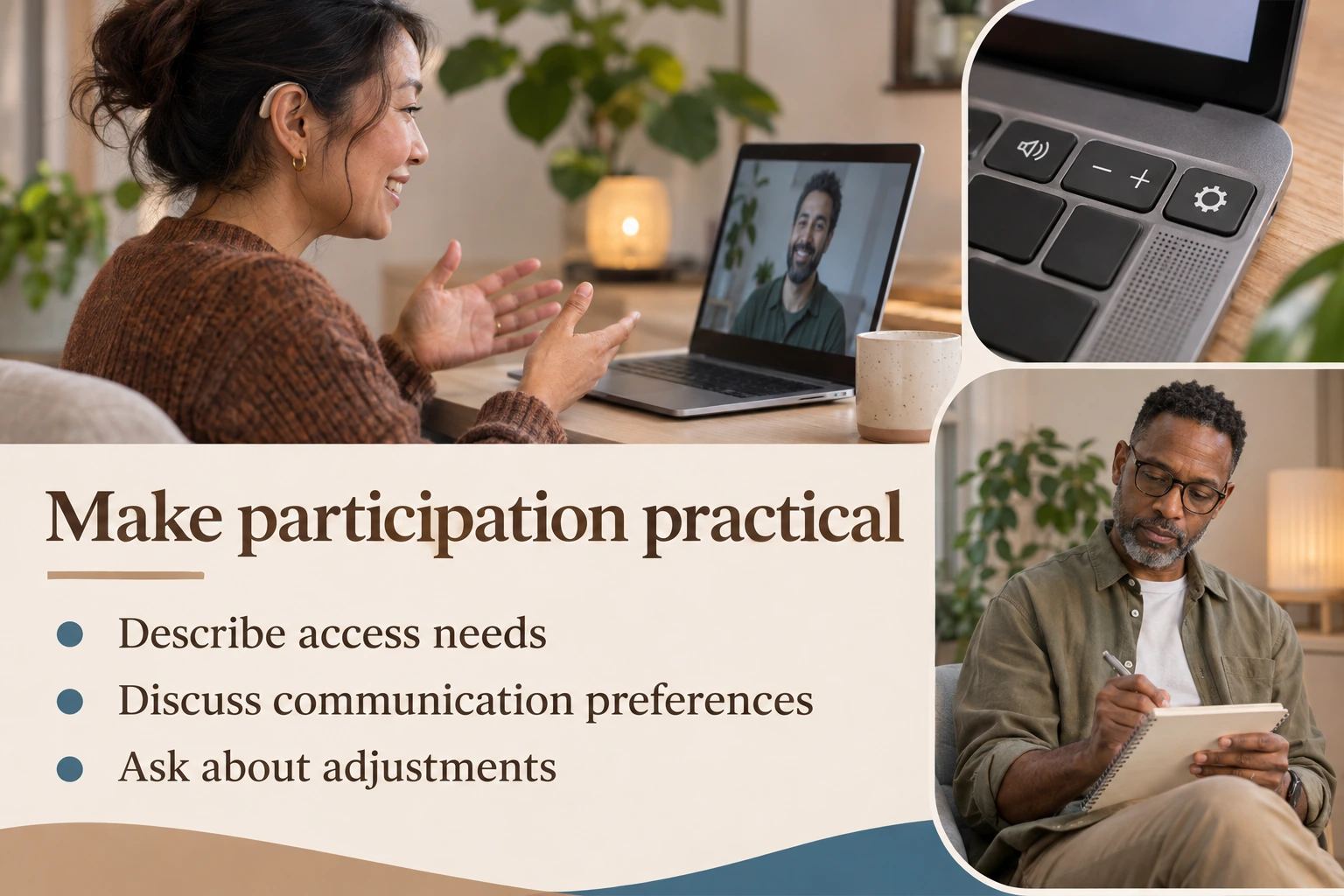
Access is easier to discuss when a need is connected to the task it affects. You might need more time to read a document, an explanation in shorter stages, a break during a long conversation or clarification of how an online meeting would work. Describing the difficulty helps establish which arrangements could be considered. You should not have to agree to an appointment before discovering whether an essential participation need can be met.
An online format may reduce travel yet introduce different problems, including a shared device, an unreliable connection or a lack of privacy. An in-person format may raise questions about travel and the meeting environment. Ask what is actually available, how arrangements are agreed and what would happen if a planned adjustment did not work. This website does not promise a particular location, interpreter, appointment format or support arrangement.
If a supporter is important to you, discuss their possible involvement in advance. Their role, confidentiality and effect on everyone else's participation need consideration. A relative cannot simply assume permission to attend, speak for someone or receive information. The same care applies when a friend makes the first enquiry. Helping a person formulate questions is different from taking responsibility for their decisions.
READING 08
Put independent advice at the points where it helps
Mediation and independent advice perform different tasks. A mediator can help a discussion remain organised and explore proposals. An adviser can explain how a proposal affects your individual rights, responsibilities or financial position. Keeping those roles clear helps prevent a useful discussion from becoming a decision made without understanding the consequences. You can ask when it would be sensible to obtain advice and what information an adviser may need.
Advice may be useful before a discussion, during a pause or after an option has been developed. There is no need to assume it belongs only at the end. A question about ownership, debt or a court deadline can change which proposals are realistic. If a point is uncertain, record the question rather than treating an untested interpretation as the basis for an agreement.
The legal effect of a record depends on the type of document and the steps taken afterwards. A summary of proposals is not automatically an enforceable order. Ask what a document is intended to do, who receives it and whether further advice or formal action is required. Do not sign or act on something simply because it emerged from an otherwise constructive meeting.
READING 09
Judge an option by how it would operate

An arrangement needs more than agreement in principle. Words such as “regularly”, “fairly” and “when necessary” can hide different expectations. Testing an option means asking what would happen on an ordinary day, what would happen when circumstances change and how the participants would know whether the arrangement was working. Useful detail reduces the number of decisions that have to be negotiated again under pressure.
For a communication arrangement, this might mean distinguishing urgent information from routine updates. For a parenting proposal, it may involve travel and exceptions. For financial matters, it may mean identifying assumptions that need confirmation. A mediator can help participants explore these questions without claiming that every disagreement will be resolved or every future difficulty anticipated. The aim is an understandable proposal, not a promise of certainty.
Progress can also mean discovering that an option does not work. An idea that depends on an impossible journey or an unverified figure may need revision. Recognising that early can save later confusion. If the discussion cannot proceed, clarify what remains unresolved and what further information or advice could help. Ending without a complete agreement does not remove the value of understanding the outstanding questions.
READING 10
Understand the boundaries of private discussion
Confidentiality is an important subject to explain before substantive participation. Ask how private assessment information, joint discussion, financial disclosure and written records are treated. They may not all have the same status. There can also be limits connected with safeguarding, legal obligations or other defined circumstances. A general reference to privacy should not be interpreted as an unlimited promise that information could never be disclosed.
Participants have responsibilities too. Consider who can hear an online meeting, whether a shared device exposes documents and how notes are stored afterwards. Do not assume that you may record a meeting or circulate its contents without agreement. Ask for the applicable arrangements and raise any uncertainty before sharing material. A practical question about privacy can be discussed without providing unnecessary sensitive detail at the outset.
The website's privacy information concerns browsing and enquiries. A later mediation service may need more detailed information about case records and disclosures. Ask for the information relevant to that stage. An explanation of website behaviour cannot establish all the practices of telephone, administrative or mediation systems, and this page does not make unsupported claims about those systems.
READING 11
Consider the service with a few concrete questions
You can assess a service more usefully when its description is translated into questions. Who would conduct the assessment? What experience and qualifications are relevant to the work being proposed? What would be charged, and when? How would suitability be reviewed? What records would be produced? These are reasonable questions before making a commitment. The website does not supply unverified biographies, accreditations, fees or availability as substitutes for answers.
Listen for distinctions between an enquiry, an assessment and a mediation appointment. They involve different decisions. Ask what you would be agreeing to at each point, what information would be expected and what terms apply to changing plans. If an explanation is unclear, request it in different words. Understanding the arrangement is part of making an informed choice, rather than an obstacle to getting started.
You may decide to take more time, obtain advice, ask another question or explore another route. Mediation should not be chosen because a web page makes the next step look inevitable. Its value depends on whether it is suitable and useful for the people involved. A telephone enquiry can help you identify the information you still need without supplying consent on behalf of anyone else.
READING 12
Separate temporary arrangements from settled proposals
A family may need an arrangement for the next few days while larger questions remain open. That immediate task should be described clearly. A short-term plan can reduce uncertainty, but it should not be mistaken for a final decision about a more complex matter. Participants can ask what the plan covers, when it will be reconsidered and which issues remain unresolved. Legal advice may be needed about the implications of acting on an interim proposal.
The distinction is especially useful when information is still being gathered. Someone may be able to discuss practical communication without being ready to evaluate a financial option. Another person may need advice about a parenting question before considering a longer-term pattern. Setting out those limits prevents the phrase “we agreed” from concealing different understandings of the scope or status of a discussion.
A review point also needs a practical meaning. It may involve checking a fact, considering advice or looking at how an arrangement has operated. It should not become an automatic renewal of something that no longer works. Ask how a concern would be raised and what happens if there is no agreement about the next stage. The process needs to remain understandable when circumstances are less straightforward than expected.
READING 13
Notice the difference between acknowledgement and agreement
Hearing another person's concern does not require accepting every detail of their account. Someone can acknowledge that a journey is difficult while disagreeing about the proposed solution. Keeping that distinction visible may make discussion less defensive. It creates room to understand a need before deciding whether a particular response is workable. A mediator can help clarify which part of a statement is being recognised and which part remains disputed.
This matters when participants worry that listening will be treated as a concession. A discussion can identify an experience, a practical consequence and a proposed answer as three different things. For instance, recognising that short-notice changes create stress does not decide which notice period is realistic. The next task is to examine the requirements and constraints behind the options, rather than infer a full agreement from a moment of understanding.
Acknowledgement also has limits. It should not become pressure to accept an inaccurate account, excuse harmful behaviour or abandon a concern that needs private attention. The ability to question and disagree remains important. If someone feels that any response will be used against them, suitability and the conditions of participation need attention before the conversation continues. A calm tone alone does not establish a fair process.
READING 14
Read the outcome as a set of defined next actions
At the end of a useful discussion, clarity may concern actions as much as proposals. One person may need a valuation, both may need advice or a practical question may need information from a relevant source. Each action should have an understandable purpose. A general instruction to “sort the paperwork” can leave participants unsure what is necessary and allow the next meeting to begin with the same gap in understanding.
It can help to distinguish who is responsible for obtaining information from who will evaluate it. Gathering a figure does not mean that the figure is accepted. Receiving a document does not mean its legal consequences are understood. The participants can identify what still needs checking and avoid using an administrative step as evidence that a substantive decision has already been made.
A record should also make unresolved matters visible. This is particularly important when several topics have been discussed and progress has varied between them. A clear description of what remains open can help an adviser understand the question and help the participants decide whether another meeting would have a useful purpose. Further work should follow the actual needs of the matter, rather than the assumption that every conversation must lead to another appointment.
READING 15
A few distinctions worth keeping in view
Does impartiality mean every proposal is equally workable?
No. Impartiality concerns the mediator's role in relation to the participants. Proposals still need information, scrutiny and practical testing. A mediator can help identify missing detail without becoming an advocate for either person. The participants should have room to question assumptions and obtain independent advice about the effect on their own position.
Must everything be discussed at once?
An agenda can distinguish urgent practical questions from longer-term matters. Whether a particular sequence is sensible depends on the case and any legal deadlines. Ask how priorities would be set and which decisions depend on information that is not yet available. A shorter agenda should not conceal an important issue or create pressure to agree prematurely.
What if speaking becomes difficult during a meeting?
Ask in advance how breaks, private concerns and changes of format are handled. A difficulty can arise after an assessment, so arrangements need to be capable of reconsideration. Continuing simply because an appointment has begun is not a substitute for checking whether participation remains suitable. The appropriate response will depend on the circumstances.